


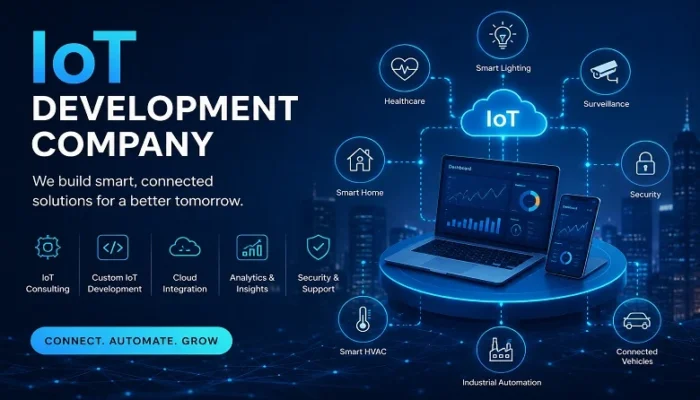
The Internet of Things (IoT) has changed how businesses collect data, monitor equipment, automate processes, and interact with connected devices. From smart manufacturing and healthcare equipment to connected vehicles, retail systems, and smart buildings, IoT technology is becoming part of everyday business operations.
However, building a successful IoT solution involves much more than connecting a device to the internet. Businesses need reliable hardware integration, secure data transmission, cloud infrastructure, mobile or web applications, analytics, and ongoing device management. Working with an experienced IoT development company can help organizations bring these different components together into a practical and scalable solution.
What Is an IoT Development Company?
An IoT development company specializes in designing and developing connected solutions that allow physical devices to communicate with software platforms, applications, and cloud environments.
An IoT system typically consists of several layers:
- Physical devices and sensors
- Connectivity and communication protocols
- IoT gateways
- Cloud or edge infrastructure
- Data storage and processing
- Web or mobile applications
- Analytics and visualization
- Security and device management
These components need to work together reliably. A problem at any stage can affect the performance of the entire system.
For example, a temperature-monitoring solution for a warehouse may use sensors to collect temperature data, transmit that information through a gateway, process it in the cloud, and display the results through a dashboard. If the temperature exceeds a predefined threshold, the system could automatically generate an alert.
What Does an IoT Software Development Company Do?
An IoT software development company focuses primarily on the software and digital infrastructure that connects IoT devices with users and business systems.
Its work may include developing:
- IoT platforms
- Device management systems
- Cloud applications
- Web dashboards
- Mobile applications
- Data processing systems
- Monitoring platforms
- Analytics solutions
- APIs and integrations
- Automation systems
The development process usually begins by understanding the business problem rather than selecting technology first.
For example, a manufacturing company may want to reduce unexpected equipment downtime. Instead of simply installing sensors, developers can design a system that collects machine data, identifies unusual patterns, displays equipment status, and sends maintenance alerts.
The value comes from turning device data into useful information and actionable decisions.
IoT Application Development Company: What Services Are Included?
An IoT application development company can build the applications that allow users to interact with connected devices and the information they generate.
These applications may be designed for different users and devices, including:
- Mobile phones
- Tablets
- Desktop computers
- Industrial control rooms
- Web browsers
- Embedded systems
Common application features include device monitoring, real-time dashboards, alerts, user management, remote controls, reports, and data visualization.
For example, a smart energy application could allow facility managers to monitor electricity consumption across multiple buildings. A mobile application could display current usage, historical trends, and alerts when consumption exceeds a predefined threshold.
How IoT Development Works
A successful IoT project generally involves several connected stages.
1. Business and Requirements Analysis
The first step is identifying the actual problem the IoT system needs to solve.
Important questions include:
- What information needs to be collected?
- Which devices will generate the data?
- How frequently should data be transmitted?
- Who will use the information?
- What actions should happen automatically?
- What existing systems need to be integrated?
- What security requirements apply?
Clear requirements help prevent unnecessary technology and features from being added to the project.
2. Device and Sensor Integration
IoT systems depend on physical devices such as sensors, cameras, meters, machines, trackers, and controllers.
The software needs to communicate reliably with these devices. Depending on the use case, integration may involve technologies such as MQTT, HTTP, Bluetooth, Wi-Fi, cellular networks, Zigbee, or other communication methods.
The appropriate technology depends on factors such as range, power consumption, data volume, environment, and reliability requirements.
3. Data Collection and Transmission
Once devices collect information, that data needs to reach the software platform.
A connected system may send information directly to the cloud or through an IoT gateway or edge device.
For applications where immediate response is important, processing some information closer to the device can reduce latency and decrease dependence on continuous cloud communication.
4. Cloud and Backend Development
The backend processes and stores information received from connected devices.
It may be responsible for:
- Device authentication
- Data processing
- Data storage
- User management
- Alert generation
- API services
- Automation
- Analytics
- Device configuration
A well-designed backend should also be capable of handling the expected number of devices and data volume.
5. Application Development
The collected information needs to be presented in a form users can understand.
This may involve a web dashboard, mobile application, desktop application, or specialized industrial interface.
A good interface should make important information easy to identify rather than overwhelming users with raw data.
6. Testing and Deployment
IoT systems require testing across both software and physical environments.
Testing may cover:
- Device connectivity
- Data accuracy
- API performance
- Network reliability
- Security
- Application usability
- Cloud scalability
- Battery performance
- Failure recovery
Testing under realistic conditions is particularly important because IoT devices may operate in environments with unstable connectivity, temperature changes, physical interference, or limited power.
Key Features of IoT Software
The exact features depend on the application, but several capabilities are common.
Real-Time Monitoring
Users can monitor connected devices and operational conditions through dashboards.
For example, a factory manager could monitor machine temperature, vibration, production status, and energy consumption.
Automated Alerts
IoT applications can generate notifications when specific conditions occur.
An alert could be triggered when:
- Temperature exceeds a threshold
- Equipment stops responding
- Energy consumption increases unexpectedly
- A vehicle leaves a defined area
- A sensor detects abnormal activity
Alerts can be delivered through applications, email, SMS, or other communication channels depending on the system.
Remote Device Management
A centralized platform can allow authorized users to configure, update, restart, or monitor connected devices remotely.
This becomes particularly valuable when devices are distributed across multiple locations.
Data Analytics
IoT systems can generate large volumes of data. Analytics tools can help convert that information into useful operational insights.
Historical data can reveal patterns involving equipment performance, energy consumption, customer behaviour, or environmental conditions.
Dashboard and Visualization
Charts, graphs, maps, and status indicators can make complex IoT information easier to understand.
A well-designed dashboard should focus on the information users actually need to make decisions.
Benefits of Working with an IoT Development Company
Industry-Specific Solutions
An experienced development partner can build the solution around the organization’s specific industry and workflow.
Faster Development
Established development processes, reusable components, and technical expertise can help reduce unnecessary development time.
Scalability
The architecture can be designed to support future increases in devices, users, locations, and data.
Better Integration
Professional developers can connect IoT systems with ERP, CRM, cloud, analytics, manufacturing, or other business platforms.
Improved Security
Security can be incorporated into device communication, APIs, cloud infrastructure, applications, and user access.
IoT Security: Why It Matters
Security is one of the most important considerations in IoT development.
Unlike traditional software, IoT systems often involve physical devices deployed outside controlled environments. A compromised device can potentially become an entry point into a larger network.
A secure IoT architecture may include:
- Device authentication
- Encrypted communication
- Secure APIs
- Access controls
- Certificate management
- Secure firmware updates
- Network segmentation
- Activity monitoring
- Vulnerability testing
- Regular security updates
Security requirements should be considered from the architecture stage rather than added after deployment.
IoT Applications Across Different Industries
IoT is not limited to smart home devices. Businesses across many industries use connected technologies.
Manufacturing
Factories can use connected sensors to monitor machines, production processes, energy consumption, and equipment health.
Predictive maintenance systems can analyze equipment data and identify potential issues before a major failure occurs.
Healthcare
IoT technology can support remote patient monitoring, connected medical equipment, asset tracking, and healthcare facility management.
Because healthcare data can be highly sensitive, security and regulatory requirements must be considered carefully.
Logistics and Transportation
Connected vehicles and tracking devices can provide information about location, fuel consumption, temperature, vehicle condition, and delivery status.
This information can improve fleet visibility and operational planning.
Agriculture
IoT sensors can monitor soil moisture, temperature, humidity, weather conditions, and other environmental factors.
Farmers can use this information to make more informed decisions about irrigation and crop management.
Retail
Connected devices can help retailers monitor inventory, store conditions, customer behaviour, refrigeration systems, and equipment.
Smart Buildings
Building management systems can use sensors to monitor lighting, temperature, occupancy, energy consumption, and security.
How to Choose the Right IoT Development Partner
Selecting a development partner requires more than reviewing a list of technologies.
Technical Expertise
Check whether the company has experience with the hardware, communication protocols, cloud platforms, backend technologies, and applications required for the project.
Relevant Experience
Industry experience can be valuable because different sectors have different operational and regulatory requirements.
Security Practices
Ask how the company approaches device security, authentication, encryption, API protection, access control, and software updates.
Scalability
The system should be capable of supporting future growth without requiring a complete architectural redesign.
Integration Capabilities
Find out whether the provider has experience integrating IoT platforms with existing business applications.
Support and Maintenance
IoT systems require ongoing monitoring, software updates, security patches, device management, and troubleshooting. Post-launch support should therefore be part of the evaluation process.
Cost of IoT Development
The cost of an IoT project can vary significantly.
Factors affecting the budget include:
- Number and type of devices
- Sensor requirements
- Communication technology
- Cloud infrastructure
- Backend complexity
- Mobile or web applications
- Data processing requirements
- AI and analytics
- Third-party integrations
- Security requirements
- Maintenance and support
A simple monitoring application may require relatively limited development, while an industrial IoT platform with thousands of connected devices and real-time analytics can require a much larger investment.
A detailed discovery and requirements phase is therefore necessary before estimating the total cost.
Common Challenges in IoT Development
IoT projects can be technically complex because they combine hardware, software, networks, and data.
Common challenges include:
Connectivity
Devices may operate in locations with weak or inconsistent connectivity. Systems should be designed to handle temporary communication failures where necessary.
Data Volume
Large numbers of devices can generate significant amounts of data. The architecture needs to process and store that information efficiently.
Device Compatibility
Different manufacturers may use different hardware and communication standards. Integration can require additional development work.
Security
Every connected device can represent a potential security risk. Device identity, access controls, encryption, and update mechanisms need to be planned carefully.
Scalability
A system that works for 100 devices may require a different architecture when expanded to 100,000 devices.
The Future of IoT Development
IoT is increasingly moving beyond simple device connectivity toward intelligent, automated systems.
Several technologies are expected to play an important role in future IoT solutions:
- Artificial intelligence
- Edge computing
- Digital twins
- 5G and advanced connectivity
- Predictive analytics
- Industrial automation
- Computer vision
- Advanced cybersecurity
The combination of IoT and AI is particularly significant. Connected devices can collect real-world information, while AI systems can analyze that information to identify patterns and support automated decisions.
For businesses, the long-term value of IoT will increasingly come from what they can do with connected data rather than simply having more connected devices.
Conclusion
IoT development combines connected devices, software, data, cloud infrastructure, and applications to create systems that can monitor conditions, automate tasks, and support better decisions. For businesses planning a connected product or enterprise solution, choosing an experienced IoT development company can help turn a technical concept into a reliable and scalable platform.
Whether the requirement involves industrial monitoring, connected vehicles, smart buildings, healthcare devices, or consumer applications, successful IoT development starts with a clear business objective. The right IoT software development company or IoT application development company should therefore focus not only on connectivity, but also on security, usability, scalability, integration, and long-term business value.
Frequently Asked Questions
A. An IoT development company designs and develops connected solutions involving devices, sensors, communication networks, cloud systems, backend platforms, mobile applications, dashboards, analytics, and integrations.
A. An IoT software development company focuses on building the software infrastructure that collects, processes, manages, and presents data generated by connected devices.
A. An IoT application development company can build web, mobile, and other user-facing applications that allow people to monitor, control, configure, and analyze connected devices and their data.
A. The timeline depends on the number of devices, software requirements, integrations, security needs, application complexity, and testing requirements. A small proof of concept can be developed much faster than an enterprise IoT platform.
A. Yes. IoT can be useful for smaller businesses when it addresses a specific operational problem, such as equipment monitoring, inventory tracking, energy management, or fleet visibility. The solution should be appropriately scaled to the company’s needs.