


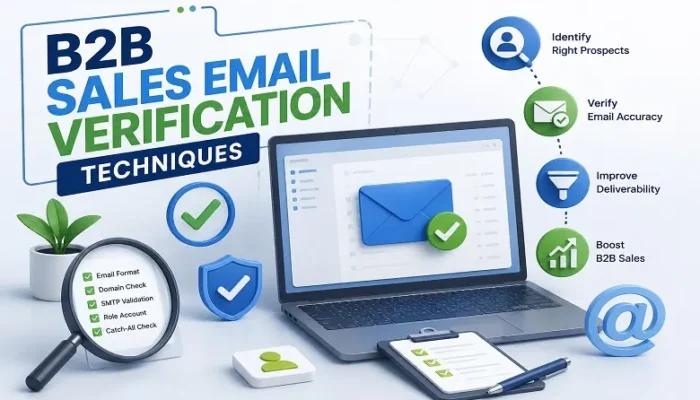
Email remains one of the most effective channels for generating B2B leads, building relationships with decision-makers, and closing high-value deals. However, even the most persuasive sales email won’t produce results if it never reaches your prospect’s inbox. That’s why implementing the right B2B sales email verification techniques is essential for every business that relies on cold outreach or email marketing.
Every year, businesses lose valuable opportunities because of outdated contact lists, invalid email addresses, employee turnover, and poor database management. These issues increase bounce rates, damage sender reputation, and reduce campaign performance. Fortunately, adopting proven B2B sales email verification techniques can help you eliminate invalid contacts, improve inbox placement, and maximize the return on every outreach campaign.
Whether you’re an SDR, sales manager, marketing professional, or business owner, understanding B2B sales email verification techniques will help you maintain a healthy email list, protect your domain reputation, and connect with more qualified prospects. In this guide, we’ll explore why email verification matters, how it works, and the best practices successful sales teams use to improve email deliverability.
What Is B2B Sales Email Verification?
B2B sales email verification is the process of validating whether a business email address is genuine, active, and capable of receiving emails before it’s added to a sales campaign.
Rather than checking only the format of an email address, modern verification tools perform multiple technical checks, including:
- Email syntax validation
- Domain verification
- MX record lookup
- SMTP verification
- Catch-all domain detection
- Disposable email detection
- Spam trap identification
- Duplicate removal
These verification steps ensure that your emails reach real people instead of inactive or invalid mailboxes.
Why B2B Sales Email Verification Is Important
Your prospect database starts losing accuracy the moment you collect it. Employees leave companies, businesses change domains, and some organizations shut down entirely. Without regular verification, your contact list gradually fills with invalid email addresses that hurt campaign performance.
Using effective B2B sales email verification techniques provides several benefits:
- Lower hard bounce rates
- Better inbox placement
- Higher email deliverability
- Improved sender reputation
- Better sales productivity
- More qualified conversations
- Increased campaign ROI
Simply put, cleaner email lists generate better sales results.
Common Reasons Business Email Lists Become Outdated
Even carefully maintained CRM databases lose quality over time.
Some of the most common reasons include:
- Employee turnover
- Company mergers
- Business rebranding
- Domain expiration
- Manual typing mistakes
- Fake lead submissions
- Purchased databases
- Duplicate records
These issues make regular email verification a necessity rather than an option.
12 Proven B2B Sales Email Verification Techniques
1. Validate Email Syntax Before Anything Else
One of the most important B2B sales email verification techniques is validating email syntax. Before checking whether a mailbox actually exists, you should confirm that the email address follows the correct formatting standards. This simple step removes obvious errors that could otherwise result in hard bounces and wasted outreach.
A properly formatted business email contains three essential components:
- A username or local part
- The “@” symbol
- A valid domain name
Examples of valid email addresses
- john.smith@company.com
- emily.jones@business.org
- david@startup.io
Examples of invalid email addresses
- johncompany.com
- john@@company.com
- john@company
- @company.com
Syntax validation cannot confirm that a mailbox exists, but it immediately filters out formatting mistakes caused by manual entry, spreadsheet imports, CRM migration errors, or poor-quality lead lists.
As the first step in successful B2B sales email verification techniques, syntax validation creates a cleaner database before deeper verification begins.
Best Practice: Verify email formatting automatically whenever new leads enter your CRM instead of waiting until campaign launch.
2. Verify the Domain
A correctly formatted email address doesn’t always mean it can receive emails. That’s why domain verification is one of the most valuable B2B sales email verification techniques for modern sales teams.
For example:
✔ sarah@techsolutions.com
✖ sarah@techsolutionz.co
✖ james@oldcompany.net
If the domain has expired, doesn’t exist, or isn’t configured for email, every message sent to that address will fail regardless of how compelling your sales copy is.
Domain verification checks whether:
- The domain is registered
- DNS records exist
- Mail servers are configured
- The business is still active
- Emails can be received
This step is particularly important when working with older prospect databases. Companies frequently change their domains after mergers, acquisitions, or rebranding, making previously valid email addresses obsolete.
Sales teams that include domain validation in their B2B sales email verification techniques experience fewer hard bounces and maintain a healthier sender reputation.
Expert Tip: If multiple contacts from the same company have invalid domains, verify whether the business has adopted a new website or email domain before removing those leads entirely.
3. Check MX Records
MX (Mail Exchange) records tell the internet which servers are responsible for receiving emails on behalf of a domain.
Even if a domain exists, missing or incorrect MX records mean emails cannot be delivered successfully.
Checking MX records helps eliminate domains that aren’t capable of receiving email and forms a critical part of professional B2B sales email verification techniques.
4. Perform SMTP Verification
SMTP verification communicates directly with the recipient’s mail server without sending an actual email.
This process helps determine whether a specific mailbox exists and is capable of accepting incoming messages.
Because SMTP validation checks mailbox availability in real time, it is considered one of the most reliable B2B sales email verification techniques available today.
5. Detect Catch-All Domains
Some companies configure their email servers to accept every incoming email regardless of whether the individual mailbox actually exists.
These are known as catch-all domains.
While catch-all domains rarely generate hard bounces immediately, they don’t guarantee your message reaches the intended recipient.
When using B2B sales email verification techniques, it’s wise to flag catch-all domains and prioritize personalized follow-ups.
6. Remove Disposable Email Addresses
Disposable email addresses are temporary mailboxes designed for short-term use.
Although uncommon in B2B environments, they occasionally appear through webinar registrations, free downloads, or online forms.
Removing these addresses helps improve overall email list quality.
7. Identify Role-Based Email Addresses
Addresses like:
- info@
- support@
- contact@
- sales@
- admin@
Often belong to shared inboxes rather than individual decision-makers.
While these addresses can still be useful, personalized outreach generally achieves higher response rates when directed toward named professionals.
8. Eliminate Duplicate Contacts
Duplicate contacts often result from importing data from multiple sources.
Sending duplicate emails damages your brand image and wastes valuable outreach opportunities.
Cleaning duplicate records is a simple but highly effective verification practice.
9. Verify Every New Lead Before CRM Import
Instead of cleaning your database every few months, verify every new lead before adding it to your CRM.
This proactive approach prevents poor-quality data from entering your sales pipeline in the first place.
10. Reverify Older Email Lists
Even verified email addresses become outdated.
Employees resign.
Companies close.
Domains change.
Reverify older prospect lists every three to six months to maintain database accuracy.
11. Monitor Campaign Bounce Reports
Verification doesn’t end once emails are sent.
Regularly analyze:
- Hard bounces
- Soft bounces
- Blocked mailboxes
- Invalid domains
These insights help improve future outreach campaigns.
12. Combine Verification with Ongoing Email List Hygiene
The best B2B sales email verification techniques are an integral part of a comprehensive database management strategy.
Regularly:
- Remove inactive contacts
- Update company information
- Merge duplicate records
- Refresh prospect lists
- Track engagement metrics
Healthy databases consistently outperform neglected ones.
Common Email Verification Mistakes
Many businesses unintentionally damage deliverability by:
- Buying outdated email lists
- Ignoring bounce reports
- Never cleaning CRM data
- Sending emails to role-based addresses without personalization
- Assuming formatted emails are valid
- Verifying lists only once
Avoiding these mistakes helps protect your sender reputation and improve campaign performance.
Best Practices for B2B Sales Email Verification
To maximize email deliverability, follow this workflow:
- Collect prospect information.
- Validate email syntax.
- Verify domains.
- Check MX records.
- Perform SMTP verification.
- Detect catch-all domains.
- Remove duplicates.
- Import verified contacts into your CRM.
- Monitor campaign reports.
- Repeat verification every three to six months.
Consistency is one of the most effective B2B sales email verification techniques for maintaining a high-quality database.
Final Thoughts
Successful outbound sales begin with accurate contact data. While compelling copy and personalized messaging remain essential, they can’t overcome poor email quality. By adopting proven B2B sales email verification techniques, businesses can enhance deliverability, decrease bounce rates, safeguard their sender reputation, and foster more meaningful conversations with qualified prospects.
Rather than treating verification as a one-time task, incorporate it into every stage of your sales workflow—from lead generation to CRM management and ongoing database maintenance. Consistently applying these B2B sales email verification techniques will help your team build healthier email lists, increase campaign performance, and create a stronger foundation for long-term B2B sales success.
Frequently Asked Questions
A. Ideally, verify every new contact before importing it into your CRM and reverify existing databases every three to six months.
A. Yes. Verified email lists reduce bounce rates, improve sender reputation, and increase inbox placement.
A. No. Verification ensures emails reach valid inboxes, but responses depend on targeting, personalization, timing, and message quality.