


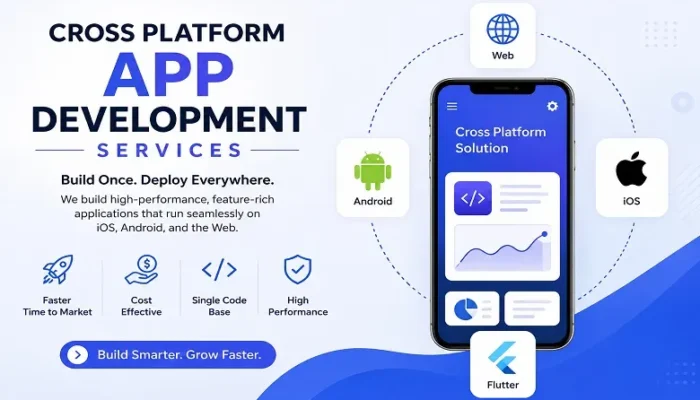
In today’s competitive digital landscape, businesses need mobile applications that deliver seamless experiences across multiple devices and operating systems. However, developing separate applications for Android and iOS can significantly increase costs, development time, and maintenance efforts. This is why many organizations are investing in cross platform app development services to accelerate innovation while maximizing return on investment.
Modern cross platform mobile app development services allow businesses to build applications using a single codebase that works across multiple platforms. This approach reduces development complexity, shortens project timelines, and enables companies to reach a broader audience without sacrificing quality.
From startups launching their first mobile product to enterprises modernizing customer experiences, cross-platform app development services have become a preferred solution for organizations seeking cost-effective, scalable, and high-performance mobile applications.
This comprehensive guide explores everything you need to know about cross-platform development, including its benefits, technologies, development process, costs, business applications, and how to choose the right development partner.
What Are Cross Platform App Development Services?
Cross platform app development services involve creating mobile applications that run on multiple operating systems using a shared codebase. Instead of building separate applications for Android and iOS, developers use specialized frameworks that allow code to be written once and deployed across different platforms.
This development approach helps businesses:
- Reduce development costs
- Launch applications faster
- Simplify maintenance
- Ensure consistent user experiences
- Reach larger audiences
As mobile technology continues to evolve, cross-platform development has become one of the most practical solutions for organizations looking to maximize efficiency while maintaining application quality.
Why Businesses Are Choosing Cross Platform Mobile App Development Services
The mobile application market is more competitive than ever. Consumers expect businesses to provide seamless digital experiences regardless of the device they use.
Developing separate native applications can be expensive and resource-intensive. Cross-platform development offers a smarter alternative.
Faster Time-to-Market
Speed often determines success in today’s business environment.
Cross-platform development enables organizations to:
- Build applications faster
- Launch products sooner
- Respond quickly to market demands
- Gain a competitive advantage
For startups, reaching the market early can be critical for attracting customers and investors.
Reduced Development Costs
One of the biggest advantages of cross platform app development services is cost efficiency.
Because developers maintain a single codebase, businesses can reduce:
- Development expenses
- Testing costs
- Infrastructure requirements
- Ongoing maintenance costs
This makes cross-platform solutions particularly attractive for startups and growing companies with limited budgets.
Consistent User Experience
Customers expect a consistent experience across all devices.
Cross-platform development allows businesses to maintain:
- Uniform branding
- Consistent navigation
- Similar functionality
- Standardized design elements
This consistency improves user satisfaction and strengthens brand identity.
Simplified Maintenance
Maintaining separate Android and iOS applications often creates unnecessary complexity.
With a single codebase:
- Updates are easier to implement
- Bugs can be fixed more quickly
- Security patches can be deployed efficiently
- New features can be released simultaneously
This significantly reduces long-term maintenance efforts.
Our Cross Platform App Development Services
Professional development companies typically provide a comprehensive range of solutions designed to support businesses throughout the entire application lifecycle.
Custom Cross Platform App Development
Every organization has unique requirements.
Custom development services focus on creating applications tailored to:
- Business goals
- Customer expectations
- Industry requirements
- Operational workflows
Custom solutions provide greater flexibility and scalability than off-the-shelf alternatives.
Flutter App Development Services
Flutter has become one of the most popular frameworks for cross-platform development.
Businesses choose Flutter because it offers:
- High performance
- Attractive user interfaces
- Fast development cycles
- Strong community support
Flutter is suitable for startups, enterprises, and consumer-facing applications alike.
React Native App Development Services
React Native enables developers to create powerful mobile applications using JavaScript.
Benefits include:
- Reusable code components
- Faster development
- Extensive third-party integrations
- Large developer ecosystem
Many successful global applications have been built using React Native.
Enterprise Mobile App Development
Large organizations often require enterprise-grade mobile solutions.
Enterprise applications may include:
- Workforce management tools
- Internal communication platforms
- Inventory tracking systems
- Customer relationship management solutions
Cross-platform frameworks can support secure and scalable enterprise applications.
Mobile App Consulting Services
A successful application starts with a clear strategy.
Consulting services help businesses:
- Define project objectives
- Identify target users
- Select the appropriate technology stack
- Estimate project budgets
- Create development roadmaps
Strategic planning reduces risks and improves project outcomes.
Flutter vs React Native: Which Framework Is Better?
Choosing the right framework is one of the most important decisions in any mobile app project.
Flutter
Flutter offers:
- Excellent performance
- Rich UI customization
- Consistent design across platforms
- Fast development with Hot Reload
React Native
React Native offers:
- Strong JavaScript ecosystem
- Faster onboarding for developers
- Extensive community support
- Proven scalability
Businesses already using JavaScript technologies often prefer React Native.
Which One Should You Choose?
The best framework depends on:
- Business objectives
- Project complexity
- Existing technology stack
- Development resources
- Performance requirements
An experienced development partner can help determine the most suitable solution.
Industries That Benefit from Cross-Platform Development
Cross platform mobile app development services support organizations across virtually every industry.
E-Commerce and Retail
Retail businesses use mobile applications to:
- Increase sales
- Improve customer engagement
- Simplify purchasing processes
- Manage loyalty programs
Mobile commerce continues to grow, making app development a strategic investment.
Healthcare
Healthcare applications support:
- Telemedicine
- Appointment scheduling
- Patient engagement
- Health monitoring
Security, privacy, and compliance are particularly important in healthcare development.
Finance and FinTech
Financial organizations rely on mobile applications for:
- Mobile banking
- Digital wallets
- Investment platforms
- Payment processing
Modern cross-platform frameworks can support advanced security requirements.
Education
Educational institutions use mobile applications for:
- Online learning
- Student communication
- Virtual classrooms
- Learning management systems
Cross-platform solutions help institutions reach students across multiple devices.
Travel and Hospitality
Travel businesses leverage mobile apps for:
- Online booking
- Reservation management
- Customer support
- Travel planning
Mobile applications enhance customer experiences throughout the travel journey.
Real-World Example: Why Businesses Choose Cross-Platform Development
Imagine a growing e-commerce company planning to launch a shopping application.
Initially, the business considered separate Android and iOS development projects. However, after evaluating costs and timelines, the company chose Flutter-based cross-platform development.
The results included:
- Faster product launch
- Lower development costs
- Simultaneous deployment across platforms
- Simplified future maintenance
This allowed the business to allocate more resources toward marketing, customer acquisition, and growth initiatives.
Our Cross Platform App Development Process
1. Discovery and Planning
Every successful project begins with a thorough understanding of business requirements.
Activities include:
- Market research
- Requirement analysis
- Competitor evaluation
- Goal definition
Proper planning reduces risks and improves project outcomes.
2. UI/UX Design
User experience plays a critical role in application success.
Design activities include:
- Wireframing
- User journey mapping
- Prototype development
- Visual design creation
An intuitive interface improves user satisfaction and retention.
3. Application Development
Developers build the application using modern frameworks and best practices.
Development typically includes:
- Front-end implementation
- Backend integration
- Database configuration
- API development
4. Quality Assurance
Rigorous testing ensures reliability and performance.
Testing activities include:
- Functional testing
- Security testing
- Performance testing
- Device compatibility testing
5. Deployment
Applications are deployed to:
- Apple App Store
- Google Play Store
- Enterprise distribution systems
6. Ongoing Support
Post-launch support ensures applications remain secure, reliable, and competitive.
Services often include:
- Performance monitoring
- Feature enhancements
- Bug fixes
- Security updates
Technology Stack Used in Cross Platform App Development
A modern development project may utilize:
Front-End Technologies
- Flutter
- React Native
- .NET MAUI
Backend Technologies
- Node.js
- Python
- PHP
- Java
- .NET
Databases
- MySQL
- PostgreSQL
- MongoDB
- Firebase
Cloud Platforms
- AWS
- Microsoft Azure
- Google Cloud
The right technology stack depends on business objectives and project requirements.
How Much Do Cross Platform App Development Services Cost?
Project costs vary depending on several factors.
Factors Affecting Cost
- App complexity
- Feature requirements
- Design sophistication
- Third-party integrations
- Security requirements
- Development timeline
Typical Cost Categories
Basic Applications
- Simple functionality
- Limited integrations
- Standard UI design
Medium Complexity Applications
- Advanced features
- User authentication
- Payment processing
- API integrations
Enterprise Applications
- Custom architecture
- Advanced security
- Complex workflows
- High scalability requirements
A detailed project assessment is necessary for accurate cost estimation.
Why Choose Our Cross Platform App Development Services?
Businesses choose experienced development partners because they provide:
- Proven technical expertise
- Industry knowledge
- Transparent communication
- Scalable solutions
- Dedicated support
- Quality assurance processes
The right partner not only develops applications but also helps organizations achieve long-term business goals.
Future Trends in Cross-Platform Development
The mobile app industry continues to evolve rapidly.
Emerging trends include:
- Artificial intelligence integration
- Machine learning features
- Progressive web applications
- Internet of Things connectivity
- Augmented reality experiences
- Cloud-native mobile architectures
Cross-platform frameworks continue to improve, offering performance increasingly comparable to native applications.
Conclusion
Investing in cross platform app development services enables businesses to build scalable, cost-effective, and high-performance mobile applications that reach users across multiple platforms. By leveraging a single codebase, organizations can reduce development costs, accelerate time-to-market, and simplify long-term maintenance.
Modern cross platform mobile app development services provide the flexibility, efficiency, and scalability needed to compete in today’s digital marketplace. Whether developing an e-commerce platform, healthcare application, enterprise solution, or customer engagement tool, businesses can benefit significantly from the speed and cost advantages of cross-platform technologies.
As mobile adoption continues to grow, organizations that embrace cross-platform app development services will be better positioned to deliver exceptional user experiences while maximizing return on investment.