


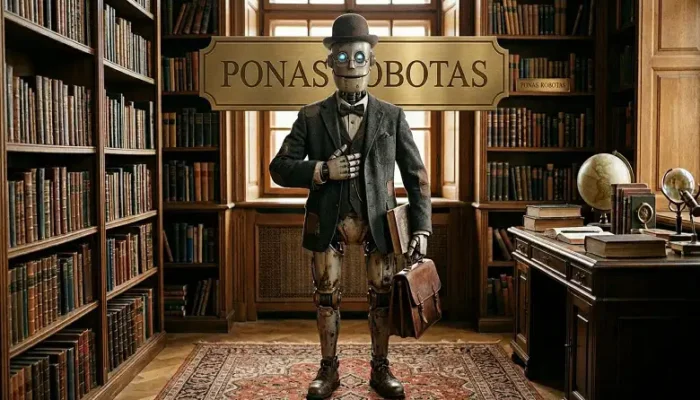
In today’s rapidly evolving digital landscape, artificial intelligence (AI) is no longer a futuristic concept—Ponas Robotas is a present-day reality shaping industries, economies, and everyday life. From automated customer service to advanced data analytics, AI systems are becoming increasingly powerful and autonomous. However, with this rise in automation comes a crucial question: how do we ensure that AI remains safe, ethical, and aligned with human values?
This is where the concept of Ponas Robotas becomes highly relevant. Ponas Robotas: Where Artificial Intelligence Meets Human Oversight represents a balanced approach to innovation—one that combines the efficiency of AI with the wisdom and accountability of human supervision. This model is not just about technology; it is about trust, governance, and the future of intelligent systems.
Understanding Ponas Robotas in the Modern AI Era
Ponas Robotas can be understood as a framework or philosophy where AI systems operate under structured human oversight. Instead of allowing machines to function independently without checks and balances, this approach ensures that human intelligence remains a guiding force.
The term reflects a hybrid ecosystem where automation enhances productivity, but humans retain ultimate control. In this model, AI handles repetitive, data-intensive tasks, while humans focus on strategic decisions, ethical considerations, and exception management.
This concept is gaining traction across industries because it addresses one of the biggest challenges in AI adoption: trust. Businesses and users are more likely to embrace AI when they know there is human accountability behind every automated decision.
The Growing Need for Human Oversight in AI
AI systems are incredibly powerful, but they are not perfect. They learn from data, and if that data is biased or incomplete, the outcomes can be flawed. Without human oversight, these errors can escalate rapidly, resulting in unintended consequences.
Human oversight plays several critical roles:
- It ensures ethical decision-making
- It reduces the risk of bias and discrimination
- It provides accountability for AI-driven outcomes
- It allows for intervention in critical situations
For example, in healthcare, AI can assist in diagnosing diseases, but doctors must validate and interpret the results. Similarly, in finance, AI can detect fraud, but human analysts review and confirm suspicious activities.
The Ponas Robotas approach emphasizes that AI should assist—not replace—human intelligence.
How Ponas Robotas Enhances AI Reliability
Reliability is one of the most important factors in AI adoption. Organizations need systems they can trust, especially when dealing with sensitive data or high-stakes decisions.
It improves reliability by introducing multiple layers of oversight:
- Monitoring Systems – Humans continuously track AI performance
- Validation Processes – Outputs are reviewed before final decisions
- Feedback Loops – Human input helps improve AI accuracy over time
- Error Handling – Humans intervene when anomalies occur
This structured approach reduces risks and ensures that AI systems operate within defined boundaries.
Key Benefits of Ponas Robotas in Modern Industries
The integration of AI with human oversight offers several advantages that go beyond automation.
Improved Decision-Making: AI can process vast amounts of data quickly, but humans bring context and judgment. Together, they create more accurate and informed decisions.
Enhanced Trust and Transparency: Users are more likely to trust systems that involve human supervision. Transparency improves when decisions can be explained and reviewed.
Risk Mitigation: Human oversight acts as a safety net, reducing the chances of costly errors or ethical violations.
Increased Efficiency: AI handles repetitive tasks, allowing humans to focus on strategic and creative work.
Scalability with Control: Organizations can scale operations using AI while maintaining control through human governance.
AI vs Human Oversight in the Ponas Robotas Model
| Aspect | Artificial Intelligence | Human Oversight |
| Speed | Extremely fast | Moderate |
| Accuracy | High (data-dependent) | Context-aware |
| Decision Making | Pattern-based | Judgment-based |
| Creativity | Limited | High |
| Accountability | Limited | Strong |
| Ethical Understanding | Minimal | Strong |
This table highlights how AI and humans complement each other, forming a balanced system under the Ponas Robotas framework.
Real-World Applications of Ponas Robotas
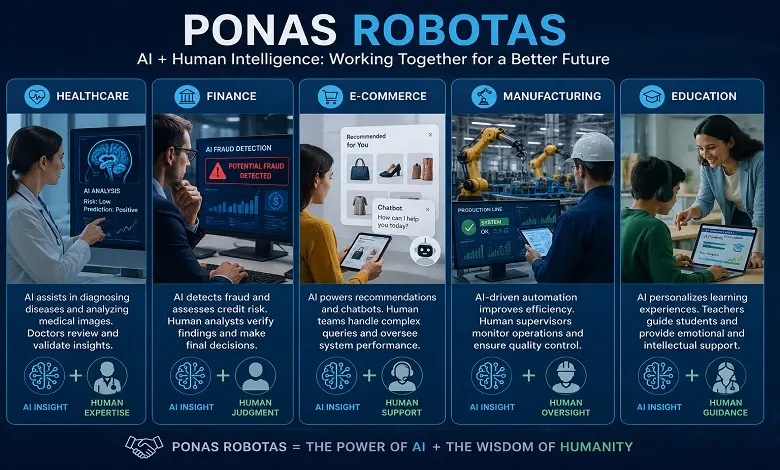
The concept of this is already being implemented across various industries, demonstrating its practical value.
Healthcare: AI assists doctors in diagnosing diseases, analyzing medical images, and predicting patient outcomes. However, medical professionals review and validate these insights to ensure accuracy.
Finance: Banks use AI to detect fraud and assess credit risk. Human analysts verify these findings and make final decisions, ensuring fairness and compliance.
E-commerce: AI powers recommendation systems and customer support chatbots. Human teams handle complex queries and oversee system performance.
Manufacturing: Automation improves production efficiency, but human supervisors monitor operations and ensure quality control.
Education: AI-driven learning platforms personalize education, while teachers guide students and provide emotional and intellectual support.
Ethical Considerations in Ponas Robotas
Ethics is a central pillar of this approach. As AI systems become more influential, ensuring ethical use becomes essential.
Key ethical concerns include:
- Bias in AI algorithms
- Data privacy and security
- Transparency in decision-making
- Accountability for errors
Human oversight helps address these issues by introducing moral judgment and responsibility into the system.
Organizations adopting Ponas Robotas must establish clear ethical guidelines and ensure that AI systems align with societal values.
Challenges in Implementing Ponas Robotas
While the benefits are significant, implementing this is not without challenges.
Complexity: Integrating AI with human oversight requires sophisticated systems and workflows.
Cost: Maintaining human involvement can increase operational costs.
Skill Gaps: Organizations need skilled professionals who understand both AI and governance.
Scalability Issues: Balancing automation with human control can be difficult at scale.
Despite these challenges, the long-term advantages outweigh the initial hurdles.
Challenges vs Solutions in Ponas Robotas Implementation
| Challenge | Solution |
| High Implementation Cost | Invest in scalable AI platforms |
| Lack of Expertise | Train employees and hire AI specialists |
| Data Bias | Use diverse and high-quality datasets |
| Monitoring Complexity | Implement automated monitoring tools |
| Resistance to Change | Promote awareness and education |
This table provides a clear roadmap for organizations looking to adopt the Ponas Robotas model effectively.
The Future of Ponas Robotas
The future of AI is not about replacing humans—it is about collaboration. Ponas Robotas represents a forward-thinking approach where technology and humanity work together.
As AI continues to evolve, human oversight will become even more important. Regulatory frameworks, ethical standards, and governance models will shape how AI is used globally.
Emerging trends include:
- Explainable AI (XAI)
- AI governance frameworks
- Human-in-the-loop systems
- Responsible AI development
These trends align perfectly with the Ponas Robotas philosophy, reinforcing its relevance in the years to come.
Why Businesses Should Adopt Ponas Robotas
For businesses, adopting Ponas Robotas is not just a technological decision—it is a strategic one.
Organizations that embrace this model can:
- Build customer trust
- Ensure compliance with regulations
- Improve operational efficiency
- Reduce risks associated with automation
In a competitive market, trust and reliability are key differentiators. Ponas Robotas provides both.
Conclusion
Ponas Robotas: Where Artificial Intelligence Meets Human Oversight is more than a concept—it is a necessity in today’s AI-driven world. By combining the strengths of machines and humans, this approach creates systems that are not only efficient but also ethical, reliable, and trustworthy.
As industries continue to adopt AI, the importance of human oversight will only grow. Ponas Robotas offers a balanced path forward, ensuring that innovation does not come at the cost of accountability.
The future belongs to those who can harness the power of AI while maintaining human control—and it is the blueprint for achieving that balance.
FAQs:
A: Ponas Robotas refers to a system where artificial intelligence operates under human oversight, ensuring control, accountability, and ethical use.
A: Human oversight ensures ethical decision-making, reduces bias, and provides accountability for AI-driven actions.
A: It is used in industries like healthcare, finance, education, manufacturing, and e-commerce.
A: It improves decision-making, builds trust, reduces risks, and enhances efficiency.
A: Yes, it represents a sustainable and responsible approach to AI development, combining automation with human control.