



If your business regularly publishes blog posts, social media updates, videos, or other marketing materials, having a clear plan is essential. Without proper planning, content creation can become inconsistent, priorities may get mixed up, and marketing efforts may fail to support business objectives. Understanding what is a content roadmap can help you organize your content activities and build a more effective marketing strategy.
A content roadmap is a strategic planning document that outlines what content a business will create, why it is important, who it is intended for, and how different content initiatives will be organized over time. It connects content marketing goals with practical activities, helping teams prioritize projects and manage their resources.
Whether you run a small business, manage a marketing team, or work as a content strategist, a well-organized roadmap can make content planning more manageable. It provides direction, improves team coordination, and helps ensure that every piece of content serves a meaningful purpose.
What Is a Content Roadmap?
A content roadmap is a structured plan that guides the creation, organization, distribution, and management of content over a specific period. It connects business objectives with content initiatives and provides a clear overview of upcoming priorities, topics, formats, responsibilities, and milestones.
Unlike a simple list of blog ideas, a content roadmap explains why particular topics deserve attention and how they contribute to broader marketing goals.
For example, a software company may want to increase brand awareness, attract potential customers, and generate more product enquiries. Its content roadmap could include educational blog articles, product comparison guides, customer case studies, video tutorials, and industry reports.
Each initiative supports a specific objective and is planned according to its importance and available resources.
A content roadmap can be maintained in a spreadsheet, project management platform, or dedicated planning tool. The format is less important than having a clear, organized view of content priorities and progress.
Why Is a Content Roadmap Important?
Creating content without a clear direction can lead to duplicated topics, missed opportunities, inconsistent publishing, and wasted resources. A roadmap helps businesses approach content production more strategically.
Here are some of its main benefits.
1. Keeps Content Aligned With Business Goals
Every business has different marketing priorities. Some want to increase organic website traffic, while others focus on generating leads, improving brand recognition, or supporting product launches.
A content roadmap connects individual content projects with these objectives.
For example, a business aiming to generate more enquiries may prioritize service pages, industry-specific guides, customer success stories, and comparison articles rather than publishing unrelated informational content.
This ensures that content creation supports measurable business priorities.
2. Improves Content Planning and Organization
A roadmap provides a centralized overview of planned content activities. Team members can understand what needs to be created, which projects are important, and how different initiatives fit together.
It also helps prevent multiple writers from working on similar topics without coordination.
3. Helps Teams Manage Resources
Content production often involves writers, editors, designers, SEO specialists, social media managers, and marketing professionals.
A roadmap helps identify the resources required for each project and distribute responsibilities more effectively.
Teams can plan workloads, identify dependencies, and avoid committing to more projects than they can realistically complete.
4. Supports Better Content Prioritization
Not every content idea deserves immediate attention.
A roadmap helps teams prioritize projects based on business value, audience demand, search opportunities, production effort, and available resources.
For example, updating an important service page that already receives traffic may be more valuable than publishing another general blog post on a similar topic.
5. Makes Progress Easier to Track
A content roadmap allows managers to monitor project status, identify delays, and review completed initiatives.
It provides visibility into what is planned, what is in progress, and what has been published. This makes it easier to identify problems and adjust priorities when necessary.
6. Creates Consistency Across Marketing Channels
Businesses often publish content across multiple channels, including websites, social media, email newsletters, and video platforms.
A roadmap helps coordinate these activities so that different channels support the same marketing themes and campaigns.
For example, publishing a detailed industry guide can create opportunities for related social media posts, email content, short videos, and downloadable resources.
What Should a Content Roadmap Include?
An effective content roadmap should contain enough information to guide decisions without becoming unnecessarily complicated.
The following elements can help create a practical planning document.
1. Content Marketing Goals
Start by identifying what the business wants to achieve through content.
Common objectives include:
- Increasing organic website traffic
- Improving brand awareness
- Generating qualified leads
- Supporting product or service launches
- Building industry authority
- Educating existing customers
- Improving customer engagement and retention
Each content initiative should connect to at least one relevant business or marketing objective.
2. Target Audience
Understanding the intended audience helps determine which topics, formats, and distribution channels are most suitable.
Consider customer needs, interests, common questions, challenges, and purchasing behavior.
For a business selling project management software, the target audience may include business owners, project managers, operations teams, and department leaders.
Each group may require different types of content depending on its responsibilities and knowledge level.
3. Content Pillars and Topics
Content pillars are the main subject areas a business wants to cover consistently.
For example, a digital marketing agency might organize its content around:
- Search engine optimization
- Content marketing
- Link building
- Social media marketing
- Website optimization
Each pillar can support multiple related topics, allowing the business to develop a connected collection of useful resources.
4. Content Formats
A roadmap should identify the formats needed to communicate information effectively.
These may include:
- Blog posts and long-form guides
- Landing pages
- Case studies
- Videos and tutorials
- Infographics
- Email newsletters
- Whitepapers and downloadable resources
- Social media posts
The format should match the audience’s preferences, the topic, and the intended marketing objective.
5. Priorities and Timelines
A roadmap should establish the order in which content initiatives will be completed.
It may use monthly or quarterly milestones to show when major projects are expected to begin or finish.
Exact publishing dates and smaller production deadlines can be managed separately in an editorial calendar.
6. Ownership and Responsibilities
Every content initiative should have a clearly defined owner.
Depending on the project, responsibilities may include research, writing, editing, design, SEO review, approval, and distribution.
Assigning ownership helps prevent confusion and makes it easier to identify who is responsible for moving a project forward.
7. Performance Metrics
A content roadmap should also identify how success will be evaluated.
Relevant metrics depend on the objective. For example:
- Organic clicks and search impressions
- Keyword visibility
- Website engagement
- Newsletter subscriptions
- Lead submissions
- Content downloads
- Referral traffic
- Assisted conversions
Measuring results helps teams understand whether their content investments are supporting business goals.
How to Create a Content Roadmap Step by Step
Building a content roadmap does not require complicated software or a large marketing department. A simple, structured process can help businesses create a practical plan.
Step 1: Define Your Business and Content Goals
Begin by identifying the main business objective behind your content activities.
Do you want to attract more website visitors, generate enquiries, promote a new service, or improve customer education?
Choose clear priorities and determine how content can contribute to them.
For example, a company launching a new software product may focus on educational articles, product comparison pages, and demonstration videos to attract and inform potential buyers.
Step 2: Understand Your Target Audience
Research the people you want to reach through your content.
Identify their common questions, challenges, interests, and information requirements. Customer interviews, sales conversations, website analytics, and search query data can provide useful insights.
Understanding audience needs helps ensure that your planned content answers relevant questions instead of focusing only on topics your team wants to write about.
Step 3: Conduct a Content Audit
Before creating new material, review the content your business already has.
Examine existing blog posts, landing pages, guides, videos, and other marketing assets.
Identify:
- Content that performs well
- Pages that need updating
- Topics with limited coverage
- Duplicate or overlapping articles
- Pages that generate enquiries
- Opportunities for internal linking
A content audit can reveal that updating existing resources may provide more value than producing entirely new content.
Step 4: Research Topics and Identify Content Gaps
Use keyword research, competitor analysis, customer questions, and industry trends to identify relevant topics.
For SEO-focused businesses, evaluate search intent, keyword relevance, ranking competition, and the potential value of each topic.
You should also examine what competitors cover and identify important questions that their content does not answer effectively.
The goal is to find opportunities where your business can provide useful, original information.
Step 5: Organize Content Into Pillars
Group related topics under broader content categories.
This makes it easier to plan connected articles and build topical coverage around important subjects.
For example, an agency focused on SEO could organize its roadmap into technical SEO, on-page optimization, off-page SEO, local SEO, and content strategy.
Each pillar can include introductory guides, detailed tutorials, comparison articles, and service-related content.
Step 6: Prioritize Content Initiatives
Evaluate potential topics based on their relevance, business value, audience demand, and production requirements.
Consider which content can support important business goals and which projects are realistic given your team’s capacity.
Prioritization helps prevent a roadmap from becoming an unmanageable list of ideas.
Step 7: Assign Resources and Milestones
Determine who will handle each project and what resources are required.
Set realistic milestones for research, drafting, editing, approval, publication, and promotion.
If a project depends on information from another department, account for that dependency when planning the timeline.
Step 8: Track Performance and Update the Roadmap
A content roadmap should not remain unchanged throughout the year.
Review performance regularly and compare results with the original objectives.
If a topic attracts relevant visitors and generates enquiries, consider creating related resources. If a planned initiative no longer supports business priorities, adjust its position or remove it.
Regular reviews help keep the roadmap relevant as business needs and audience interests change.
Content Roadmap vs. Content Strategy vs. Content Calendar
These three terms are closely related, but they serve different purposes in content marketing.
A content strategy establishes the overall direction, a content roadmap organizes the initiatives and priorities, and a content calendar manages individual publishing activities.
| Factor | Content Strategy | Content Roadmap | Content Calendar |
| Main purpose | Defines the overall direction | Organizes content priorities and initiatives | Schedules content publication |
| Key question | Why are we creating content? | What should we create and in what order? | When will each item be published? |
| Focus | Audience, goals, positioning | Topics, formats, priorities, milestones | Dates, channels, and publishing tasks |
| Timeframe | Long-term | Usually monthly or quarterly planning | Daily, weekly, or monthly |
| Main users | Marketing leaders and strategists | Content managers and marketing teams | Writers, editors, and publishing teams |
For example, a business may have a content strategy focused on attracting small business owners through educational resources.
Its content roadmap could prioritize guides about business software, financial management, and productivity over the next quarter.
The content calendar would then assign specific publication dates, writers, editing deadlines, and distribution channels to each article.
All three work together to make content marketing more organized and purposeful.
Example of a Simple Content Roadmap
Consider a digital marketing agency that wants to increase organic website traffic and attract more businesses interested in SEO services.
Its content roadmap could include the following initiatives:
| Period | Content Topic | Format | Business Objective |
| Month 1 | Complete SEO Guide for Small Businesses | Blog Guide | Increase organic visibility |
| Month 1 | Technical SEO Checklist | Downloadable Resource | Generate leads |
| Month 2 | On-Page SEO Best Practices | Blog Article | Build topical coverage |
| Month 2 | SEO Case Study | Case Study | Build credibility |
| Month 3 | Local SEO Strategies for Businesses | Blog Guide | Attract relevant customers |
| Month 3 | SEO Services Comparison Guide | Comparison Article | Support purchase decisions |
This example provides a high-level view of the planned content initiatives. The agency can use a separate content calendar to manage individual article deadlines, assignments, and publishing dates.
The roadmap can also be adjusted based on keyword performance, customer enquiries, available resources, and changes in business priorities.
Common Mistakes to Avoid When Creating a Content Roadmap
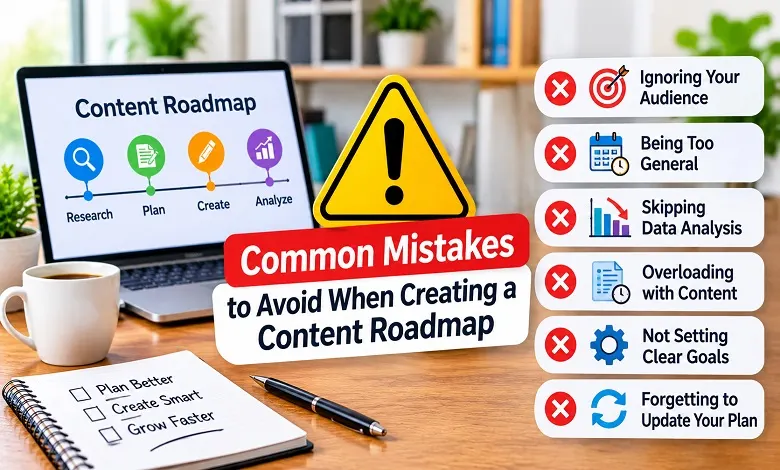
A roadmap is useful only when it reflects realistic priorities and provides direction for the team. Certain planning mistakes can reduce its effectiveness.
1. Creating Content Without Clear Goals
Publishing frequently does not automatically produce business results. Every major content initiative should have a defined purpose and a relevant success measure.
2. Ignoring Audience Requirements
Choosing topics only because they have high search volume can lead to content that attracts visitors without addressing their actual needs.
Understand search intent and customer expectations before adding topics to your roadmap.
3. Planning Too Much Content
An overloaded roadmap can create unrealistic expectations and put pressure on writers and editors.
Focus on a manageable number of valuable initiatives instead of trying to publish as much content as possible.
4. Forgetting Existing Content
Many businesses focus entirely on new articles and overlook older resources that need improvement.
Content updates, consolidation, and optimization should be considered alongside new content production.
5. Not Assigning Clear Responsibilities
When ownership is unclear, projects can experience delays and missed deadlines.
Assign a responsible person to each initiative and define the main tasks required for completion.
6. Failing to Review Performance
A roadmap should evolve as new information becomes available.
Regularly review performance metrics and adjust content priorities based on what is working and what needs improvement.
Tools That Can Help Manage a Content Roadmap
The right tools can make content planning, collaboration, and progress tracking easier.
The best option depends on your team size, workflow, and planning requirements.
Google Sheets: Useful for creating a simple roadmap with topics, priorities, owners, milestones, and status updates.
Trello: Helps teams organize content projects using boards, lists, and task cards.
Asana: Supports project planning, task assignments, deadlines, and team collaboration.
Airtable: Combines spreadsheet-style organization with database features, making it useful for managing larger content libraries and workflows.
Notion: Allows teams to organize content plans, research notes, project documentation, and editorial processes in one workspace.
Regardless of the platform, choose a system that your team can maintain consistently. A simple, regularly updated roadmap is more useful than a complicated tool that nobody uses.
Conclusion
Understanding what is a content roadmap is important for businesses that want to create organized, goal-driven content rather than publishing without a clear direction. It provides a structured way to connect marketing objectives with content priorities, audience requirements, production activities, and performance measurement.
By defining goals, researching topics, auditing existing resources, assigning responsibilities, and reviewing results, businesses can build a roadmap that supports both short-term campaigns and long-term marketing growth.
A successful content roadmap does not need to be complicated. It needs to be realistic, easy to manage, and closely connected to business objectives. With consistent planning and regular improvements, it can help marketing teams create more relevant content, use resources effectively, and achieve better results.
Frequently Asked Questions
A. A content roadmap is a plan that shows what content a business intends to create, why it matters, who will be responsible, and how the work will progress over time. It helps teams organize content activities around specific marketing and business goals.
A. The main elements include business goals, target audiences, content pillars, topics, formats, priorities, timelines, ownership, and performance metrics. These elements provide a clear overview of planned content initiatives.
A. A content roadmap focuses on strategic priorities and upcoming content initiatives, while a content calendar manages specific publishing dates and production activities. The roadmap establishes direction, and the calendar helps execute the plan.
A. Content managers, marketing strategists, SEO specialists, and business owners can create content roadmaps. Larger organizations may involve writers, designers, sales teams, and product managers to ensure that content initiatives support broader business objectives.
A. Many businesses review their roadmaps monthly and conduct a more detailed review quarterly. However, the frequency depends on content volume, industry changes, campaign requirements, and business priorities.
A. Yes. A content roadmap can help small businesses organize limited resources, identify important topics, maintain publishing consistency, and focus on content that supports their marketing objectives.
A. Google Sheets, Trello, Asana, Airtable, and Notion are useful options. Businesses can choose based on their workflow requirements, team size, collaboration needs, and budget.