


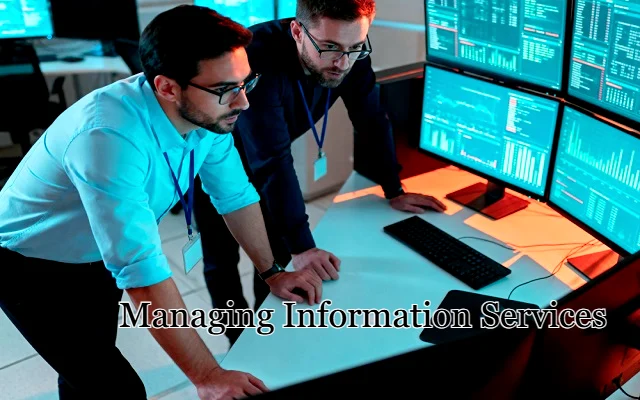
Technology has quietly moved from being a support tool to becoming one of the most critical parts of how businesses function. Almost every daily activity—sending invoices, communicating with customers, tracking inventory, running payroll—depends on systems working the way they should. For that to happen, managing information services must be more than a background task. It has to be a thoughtful, ongoing responsibility that keeps the organization stable and prepared for change.
Many companies don’t realize how much they depend on information services until a network goes down or an important file becomes inaccessible. When that happens, productivity comes to a standstill. A strong information service framework prevents those situations and ensures that technology serves the business, not the other way around.
What Managing Information Services Really Means in Today’s Business Environment
Managing information services used to mean maintaining a few computers and keeping basic software up to date. Today, it involves an entire ecosystem. Businesses now rely on complex networks, cloud platforms, cybersecurity tools, workflow applications, and digital communication channels.
Under this umbrella, teams must handle:
- Infrastructure and hardware planning
- Data security and backup strategies
- Software licensing and maintenance
- Helpdesk and end-user support
- Network management and monitoring
- Vendor coordination
- Cloud and hybrid environments
- Disaster recovery readiness
Each area carries its own challenges. For example, storing data safely is no longer just a technical decision—it’s part of legal compliance. Running a network is not just about cables and routers—it includes performance monitoring, load balancing, and cybersecurity. All of these responsibilities sit inside the broader effort of managing information services.
Understanding the Role of Information Technology Service Management
As businesses became more dependent on technology, they needed a structured way to manage it. That shift is what led to information technology service management, often shortened to ITSM.
What Is Information Technology Service Management?
Instead of viewing IT as a collection of tasks, information technology service management introduces discipline and consistency. It guides how issues are handled, how changes are approved, and how services are delivered to employees or customers.
Think of ITSM as a framework that ensures IT work is organized rather than reactive. It builds processes around:
- Incident response
- Service requests
- Hardware and software management
- Change control
- Asset tracking
For example, if the company decides to roll out a new software package, ITSM provides the steps: evaluation, testing, approval, deployment, and monitoring. Without that structure, even simple updates can cause downtime.
At its core, information technology service management is about delivering a predictable, high-quality experience every time someone relies on technology—which, in most organizations, is every minute of the workday.
Why ITSM Is a Game-Changer for Modern Organizations

Companies turn to ITSM because it prevents inefficiency and reduces the risk of costly mistakes. Once even a basic ITSM structure is implemented, several things improve almost immediately:
1. Predictable and reliable service
Employees stop guessing how long a fix will take or who to contact. Instead, they follow a clear system that ensures faster solutions.
2. Stronger security foundation
ITSM enforces routine patching, password policies, monitoring, and early detection—an approach that protects the company from preventable threats.
3. Reduced downtime
A structured environment eliminates the “panic mode” IT teams often face when something breaks unexpectedly.
4. Improved communication across departments
IT is no longer a mystery. Other departments understand what is happening, why it matters, and how changes affect operations.
5. Better budgeting and cost control
When processes are consistent, so is spending. Businesses waste less money on redundant tools and emergency outsourcing.
This is why even small companies with limited IT staff often see big improvements after adopting ITSM methods.
Information Technology Managed Services: How Modern Businesses Stay Ahead
Some organizations simply don’t have the time, staff, or resources to manage IT demands on their own. As technology grows more complicated—cloud servers, cybersecurity, remote work systems—businesses need specialists they can rely on without hiring full-time teams.
This is where information technology managed services enter the picture.
What Are Managed Information Technology Services?
These services are provided by Managed Service Providers (MSPs) who take over part or all of the company’s IT responsibilities for a monthly fee. Instead of reacting to problems, MSPs focus on preventing them.
They typically manage:
- System monitoring around the clock
- Cybersecurity defenses
- Employee tech support
- Data storage and backup
- Software updates and patching
- Cloud system management
- Network maintenance
- Compliance and reporting
For many companies, especially those growing quickly, using managed information technology services is the only practical way to keep systems secure and stable without overwhelming their internal staff.
How Managed IT Services Strengthen Business Performance
Businesses rarely choose managed services just to reduce workload. They choose them because they want to operate with fewer disruptions and more confidence.
Here’s what usually improves:
1. Constant monitoring, not just occasional checkups
MSPs use tools that alert them immediately if something unusual happens—before employees even notice an issue.
2. A stronger cybersecurity posture
Cyber risks have grown sharply, and MSPs bring layered protection that small internal teams often cannot set up alone.
3. Lower and more predictable IT expenditure
Instead of paying unpredictable repair costs, companies budget ahead with fixed monthly rates.
4. Access to specialized expertise
MSPs employ network engineers, cloud specialists, cybersecurity analysts, compliance experts, and more—skills that are extremely expensive to hire individually.
5. Fewer disruptions and smoother operations
Proactive maintenance prevents many of the problems that normally lead to downtime.
6. Scalable systems that grow with the business
MSPs help plan upgrades and expansions, ensuring that the company doesn’t outgrow its technology.
Managing Information Services vs. Managed Information Technology Services
The distinction is simple:
Managing information services refers to the internal work done by a company’s own IT team.
Managed information technology services are outsourced to teams taking on those responsibilities externally.
| Category | In-House Managing Information Services | Managed Information Technology Services (External) |
| Staffing | Internal IT employees | Specialists from an MSP |
| Cost | Salaries, training, equipment | Flat monthly fee |
| Expertise | Limited to internal skills | Broad expertise across fields |
| Control | Full internal control | Shared responsibility |
| Best For | Companies wanting deep control | Companies wanting scalability |
Many organizations choose a hybrid model because it combines control with expert support.
Core Components of Effective Information Service Management

Companies that excel at managing information services usually do well in these core areas:
1. Infrastructure and Network Management
A business cannot function if its network is unstable. Monitoring performance, upgrading hardware, and ensuring connectivity are foundational responsibilities.
2. Data Governance and Storage
Data is one of the most valuable assets a business owns. It must be stored securely, backed up regularly, and protected against unauthorized access.
3. Cybersecurity and Risk Prevention
Modern threats require more than antivirus software. Businesses need structured security policies, monitoring, employee training, and regular assessments.
4. Software and Application Management
Applications must be updated, supported, and integrated carefully. A single outdated tool can become a major vulnerability.
5. Helpdesk and End-User Support
Employees need fast, reliable support. A slow IT response affects productivity across the entire company.
6. Cloud Management
Cloud platforms offer flexibility but require continuous configuration, monitoring, and cost management.
7. Documentation and Compliance
Proper documentation ensures continuity, and compliance protects the company from legal and financial risks.
How IT Service Management Supports Digital Transformation
When companies decide to adopt new technologies, ITSM provides the structure that helps them transition smoothly.
It supports transformation by:
- Reducing human error through automation
- Standardizing workflows
- Making cloud migrations smoother
- Supporting remote work environments
- Helping leadership make informed decisions
With ITSM, technology changes don’t feel chaotic—they follow a predictable pattern.
Best Practices for Managing Information Services in Any Organization
Businesses that build strong information service environments usually follow a few consistent principles:
1. Build processes before you build systems
Without a process, even the best technology will confuse.
2. Prioritize cybersecurity first
Security cannot be added halfway through—it must be part of the foundation.
3. Use a mix of internal staff and external expertise
Most companies benefit from combining both.
4. Document everything important
Documentation saves time, money, and headaches when staff change or systems evolve.
5. Evaluate IT performance regularly
Quarterly reviews help identify weak spots and opportunities for improvement.
6. Adopt a cloud-first mindset
Cloud systems give businesses flexibility that physical hardware cannot match.
The Real Value of Well-Managed Information Services
Companies see several positive outcomes when they take information services seriously:
- Faster workflows
- Better customer experiences
- Lower risk of data loss
- Improved decision-making
- Reduced downtime
- Stronger long-term stability
In short, managing information services has a direct and measurable impact on business success.
Looking Ahead: The Future of IT Service Management and Managed Services
The next few years will bring even bigger changes in how organizations manage technology. Among the most significant trends are:
- AI tools that detect issues automatically
- Security models that verify every access attempt
- Companies moving deeper into cloud-only environments
- Unified dashboards that show an entire IT ecosystem at a glance
- Faster disaster recovery through automation
Organizations that prepare now will gain a competitive edge as these shifts accelerate.
Conclusion
Managing information services is no longer something businesses can treat as an afterthought. It affects productivity, customer satisfaction, security, and the overall health of the organization. When supported by strong information technology service management practices and reinforced with reliable managed information technology services, companies gain the stability and flexibility they need to grow confidently.