


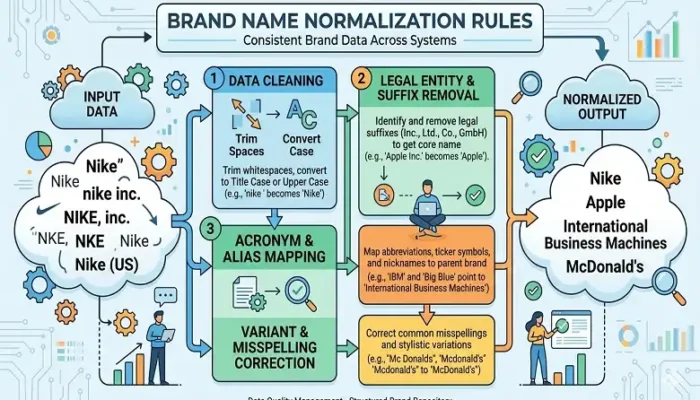
In any business that handles data—whether it’s marketing, e-commerce, CRM, or analytics—brand names rarely stay consistent. The same company might appear in different forms across systems, such as slight spelling changes, added suffixes, or variations in formatting. Over time, these small differences create bigger problems.
This is where brand name normalization rules become important. They provide a structured way to clean, standardize, and unify brand names so that every variation points to one consistent version. Instead of dealing with duplicate or mismatched entries, businesses can rely on accurate and organized data.
When applied correctly, normalization improves reporting, strengthens SEO signals, and ensures that systems recognize brands properly across platforms. It’s not just a technical process—it’s a foundational step toward better data quality and clearer brand identity.
What Are Brand Name Normalization Rules?
Brand name normalization rules are predefined logic patterns used to convert inconsistent brand name variations into a single standardized format.
In practical terms, this means taking different versions of a brand name—such as “Coca Cola,” “Coca-Cola,” and “coca cola”—and mapping them to one accepted form. The goal is simple: one brand, one consistent representation across all systems.
These rules are commonly used in:
- CRM systems
- Product catalogs
- Marketing databases
- SEO and content platforms
Without normalization, systems treat each variation as a separate entity. With normalization, everything becomes unified and easier to manage.
Why Brand Name Normalization Matters in Real Use
The importance of brand name normalization rules becomes clear when you look at how data is used in everyday operations.
Inconsistent brand names can lead to duplicate records, inaccurate reporting, and confusion during analysis. For example, a company might appear multiple times in a sales report simply because of slight differences in naming.
Normalization solves this by creating consistency. It ensures that all data related to a brand is grouped, making it easier to track performance and make decisions.
It also improves trust and recognition. When a brand appears consistently across platforms, it becomes easier for users and systems to identify it correctly.
Core Brand Name Normalization Rules Explained
To understand how normalization works, it helps to look at the key rules used in the process. These rules are simple on their own, but together they create a powerful system.
Removing Legal Entity Suffixes
Many brand names include legal suffixes such as Inc., LLC, Ltd., or Corp. While these are important legally, they often add unnecessary variation in data systems.
For normalization, these suffixes are usually removed so that the focus remains on the core brand name. For example, “Salesforce, Inc.” becomes “Salesforce.”
There are exceptions, especially when the suffix is part of the actual brand identity, but in most cases, removing them improves consistency.
Standardizing Capitalization
Capitalization is one of the most common sources of inconsistency. A brand might appear in uppercase, lowercase, or mixed formats depending on how it was entered.
Normalization rules define a consistent format, such as title case. This ensures that “APPLE,” “apple,” and “Apple” are treated as the same brand.
However, some brands have specific styling, such as “eBay” or “iPhone,” which should be preserved.
Handling Punctuation and Special Characters
Punctuation can create multiple variations of the same name. Hyphens, commas, and symbols often differ depending on the source.
For example, “Coca-Cola” and “Coca Cola” may appear differently but refer to the same brand. Normalization rules standardize or remove such characters to avoid duplication.
Consistency in handling punctuation ensures that systems do not treat these variations as separate entities.
Managing Abbreviations and Full Names
Some brands are known by both abbreviations and full names. For example, “IBM” and “International Business Machines” represent the same company.
Normalization rules define which version should be used as the standard. The choice depends on context, but once selected, it must remain consistent.
This helps prevent confusion and ensures accurate matching across datasets.
Correcting Spelling Variations
Human error is inevitable in data entry. Misspellings and slight variations can easily appear in large datasets.
Normalization rules include mapping these incorrect versions to the correct brand name. This ensures that all references point to the same entity.
Over time, this significantly improves data accuracy and reliability.
How Brand Name Normalization Works in Practice
Applying brand name normalization rules is not just about defining them—it requires a clear process.
The first step is identifying where brand names exist. This could include databases, spreadsheets, marketing tools, and customer records.
Next, a standard version of each brand name is defined. This becomes the reference point for all normalization.
Then, rules are applied to clean and transform existing data. This can be done manually for small datasets or automated for larger systems.
Finally, ongoing monitoring ensures that new data follows the same standards. Without this step, inconsistencies can return over time.
Benefits of Brand Name Normalization Rules
The impact of normalization becomes more visible as data grows.
One of the biggest benefits is improved accuracy. When all brand names follow a consistent format, reports and analytics become more reliable.
Another benefit is better search performance. Normalized data helps systems recognize brands more effectively, improving search results and recommendations.
It also reduces duplication, saving time and effort. Instead of managing multiple entries for the same brand, everything is consolidated into one.
In addition, normalization supports automation and AI systems by providing clean, structured data.
Role of Brand Name Normalization in SEO
Normalization is not just a data management practice—it also plays a role in SEO.
Search engines rely on consistent signals to understand entities. When brand names appear in multiple formats, it can weaken recognition.
Using standardized brand names helps search engines associate content with the correct entity. This improves visibility and strengthens brand authority.
It also reduces confusion for users, making it easier to find and recognize the brand across different platforms.
Challenges in Applying Normalization Rules
While the concept is simple, applying brand name normalization rules can be challenging.
One common issue is handling exceptions. Some brands intentionally use unique formatting or include special characters.
Another challenge is dealing with multiple data sources. Each system may have its own naming conventions, making standardization more complex.
There is also a balance to maintain. Over-normalization can remove important details, while under-normalization leaves inconsistencies.
Addressing these challenges requires careful planning and regular updates.
Best Practices for Effective Normalization
To make normalization effective, it’s important to follow practical guidelines.
Start with clear and simple rules that can be applied consistently. Avoid overly complex logic that is difficult to maintain.
Create a central reference list of standardized brand names. This acts as a single source of truth.
Use automation tools where possible, especially for large datasets. These tools can apply rules quickly and reduce manual effort.
Regularly review and update your data to ensure ongoing consistency.
Most importantly, ensure that everyone involved follows the same standards.
Real-World Example of Brand Name Normalization
Imagine an e-commerce platform selling products from multiple brands. Without normalization, the same brand might appear in several forms, making it difficult to track performance.
After applying normalization rules, all variations are merged into a single entry. This provides a clear view of sales and simplifies reporting.
Another example is CRM systems. When company names are normalized, it becomes easier to match records and avoid duplicates.
These examples show how normalization improves both efficiency and decision-making.
Final Thoughts
Brand name normalization rules may seem like a small detail, but they have a significant impact on how data is managed and understood. Without them, even well-structured systems can struggle with inconsistencies.
By applying clear rules and maintaining consistency, businesses can improve accuracy, simplify operations, and strengthen their digital presence. Whether you’re working with customer data, product catalogs, or SEO strategies, normalization provides a reliable foundation.
In the long run, it’s not just about cleaning data—it’s about creating clarity, consistency, and trust across every platform where your brand appears.
FAQs About Brand Name Normalization Rules
A: They are guidelines used to standardize brand names into a consistent format across systems.
A: They improve data accuracy, reduce duplication, and support better analysis.
A: Converting “coca cola,” “Coca-Cola,” and “COCA COLA” into one standard name.
A: Yes, many tools and systems can apply normalization rules automatically.
A: Yes, it helps search engines recognize and associate brand names more accurately.